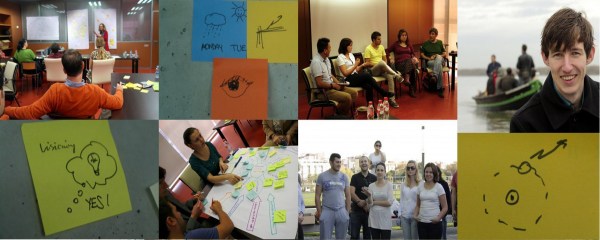
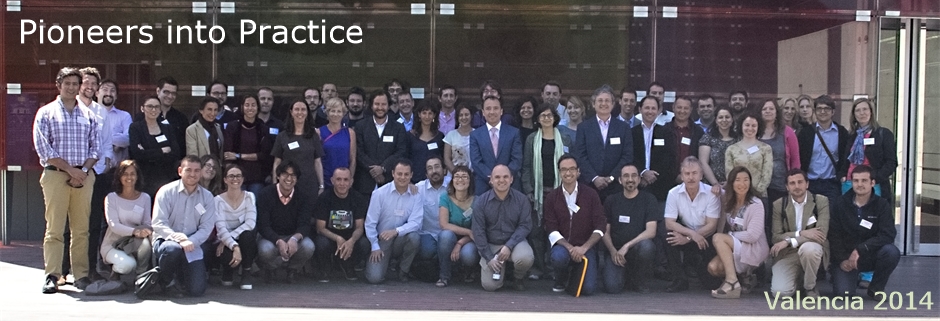
Climate-KIC offered an eight day coached sustainability transitions course for experienced environment and water management professionals, held in Valencia (Spain) from 22nd until 29th November 2014. It was designed to provide the key competencies and capabilities to be an innovator in the broad sense of this term. More than 35 people, from 15 different countries, were working on ‘Green skills’ in a programme designed to upgrade professional competences to face climate and sustainability challenges. The principal novelty of the course was to introduce horizontal and cooperative methods of working, involving low-profile hierarchies and greater autonomy. Hence, participants were collaborating hand-by-hand with international, regional specialists and problem owners related with climate change within a “project meeting” atmosphere.
Cristian Matti, social science researcher, together with Professor Anne J. Wieczorek and Coach Javier de Vicente, coordinated a team of well-known international experts including Jan Jonker, Corporate Sustainability; Todd Gartner, Water Management and Innovation; Caroline Van Leenders, Process Manager in Sustainable Transitions; and, Fernando J. Díaz López, Eco-innovation for Green economies. Furthermore, several regional experts participated in debates activities trying to reproduce real working negotiations with stakeholders. Additionally, participants have enjoyed study visits to actual projects in the regeneration area of Turia River and Naturals Park l´Albufera. A diverse set of activities such as breakfast and lunch seminars, workshops, world cafe or pitching, were performed horizontally in order to help participants to realize which skills are needed the most to deal with sustainability transitions enforced by climate change: thus, first, to be able to identify barriers, identify opportunities or stakeholders analysis; second, to be able to develop solutions –new business models– with system innovation projects, focus priorities for further exploration or low carbon innovation; and, finally, make transitions happen –plans into actions–. This pilot initiative performed as a living lab experience for both participants and experts who explored new learning techniques by shifting the role of experts, participants and speakers towards a more horizontal context of professional interaction. This particular program forms part of the Innovator Catalyst series and was aimed at experienced professionals with the enthusiasm and potential for influencing organizational change and system innovation. It was also organized by INGENIO (CSIC-UPV), Polytechnic University of Valencia and Vaersa.
Take a look at our experience
https://www.youtube.com/watch?v=8tZvRwIJzjM&t=4s
Innovator catalyst roadmap


 CRISTIAN MATTI
