Wind Energy in Spain: a review of the policy mix

Cristian Matti & Davide Consoli

The European Community (EC) has proactively promoted the development of renewable energy for over 20 years by means of standards and regulation designed to align incentives and opportunities. These actions have spurred a variety of responses and modes of implementation with distinctively local characters among member states. The diffusion of wind energy in Spain is a good case in point to illustrate how coordinated multi-level environmental policy can successfully promote the emergence of new sectors. Building on a wide platform of supranational and national directives, Spanish regional governments have designed and implemented development strategies based on the mobilization of locally available assets. This has resulted in differential growth of industrial, research and policy capacities across regions, and a rich spectrum of development trajectories that leverage on and feed back into regional-specific tangible and intangible assets. This chapter outlines the intertwining of technological, industrial and institutional developments that allowed Spain to become an active pole of innovation and growth in the wind energy sector.

Book: The Economics of Knowledge, Innovation and Systemic Technology Policy

Visioning for the biomass sector. Fostering local development through participatory processes


Javier de Vicente López, Cristian Matti and José Jiménez Pérez

This document summaries the results obtained as a result of the participatory process that is part of the “Foundations for a Provincial Strategy Biomass” in the province of Castellon.
These actions are ultimately aimed at laying the foundations for sustainable biomass strategy, which included the set of actors in the territory and the entire value chain that the use of biomass genera.La idea behind all the participatory process It is incorporating the different viewpoints, knowledge and experience of all actors in the work of treating biomass as “an element to assess forest biomass” capable of “generating economic wealth, clean energy and employment, especially in the interior villages helping the development of these rural areas. ”

Download report here: Report Biomass Castellon – Participatory methods 2015 (in Spanish)

Wind energy, knowledge creation and multilevel governance

The Spanish wind energy rise. Pathways of knowledge creation in a multilevel environmental governance system

PhD Dissertation 2015 Cristian Matti

My DPhil research project analyses the long term pathways of knowledge creation within and across a multilevel environmental governance system. Emphasis will be put in the strategies for pursuing energy security of supply and for supporting renewable industry in Spain by considering areas of technology development and environmental policy through networks articulation.
The study focuses on mechanism for knowledge creation as part of government and industry response to the current multilevel framework on energy and environment. In doing so, this research seeks to identify the major contributors to the emergent knowledge base, be they individuals, research organizations, governmental agencies or firms. Finally, it will analyze the reasons behind differences in performance among Spanish regions.
This research will try to identify key environmental policy and technology factors that contributed to the development of wind energy sector in Spain. Emphasis will be put in the implementation pattern of policy instruments that facilitated pathways to develop renewables energy regionally as well as the extent to which the recombination of existing knowledge and new forms of organization within and across the value chain affected emergent technological capacity.
Theoretically, the research seeks to contribute to the understanding of the development of an emergence sector among a multilevel governance context but putting particular emphasis on interaction and interdependences within and across areas of technical development and environmental policy. It also aims to get a better understanding of processes of adaptation and integration of polices (emanating from higher hierarchical levels) to local context as a strategic response to face new challenges and opportunities.

PhD dissertation available HERE

Policy Incentives for the Creation of Knowledge: Methods and Evidence (PICK-ME)

The ongoing global economic crisis is seriously challenging advanced capitalistic economies. In the last year the GDP has fallen at dramatic rates, creating the conditions for the upsurge of unemployment, above all in areas characterized by specialization in mature industries. According to recent growth models and empirical evidence, innovation and knowledge creation represent the main factors able to improve the competitiveness and the long run perspectives of growth of countries. Yet, innovation and technology policies have mainly been designed by relying on a supply side perspective so as to affect the creation of knowledge by providing funds to carry out R&D activities and by enhancing education and training for researchers. However, a debate has recently emerged, about the need for grafting innovation and technology policies in a demand-oriented framework.
Logic_050312
The aim of this project is to provide an original contribution to the ongoing debate, advancing the understanding of the mechanisms through which demand-based innovation policies may stimulate effective knowledge creation process, and eventually trigger competitiveness and productivity growth. To this purpose, the research activity will consist of both theoretical models and empirical analyses, the results of which should be able to inform the policy design process. We shall distinguish between public and private demand for both final and intermediate goods and services and will analyze their effects on the generation, diffusion and exploitation of technological knowledge by articulating the research activity on different dimensions (regional, sectoral and institutional). The research activity will be conducted by pursuing a great deal of multidisciplinarity and combining a number of diverse methodologies. The results of the analyses will in turn provide the basis upon which a taxonomy of demand-oriented technology policies may be elaborated.
Last and not least, my Dphil research project was the main input of the proposal for the study on Spanish wind energy sector included in PICK ME. Thus, the resulted project has provided an excellent academic environment to explore, validate and improve my research project.

Scientific outputs

Multi-level governance, policy mixes and wind energy in Spain

Quality of life, social innovation and living lab methodologies

Fostering quality of life through social innovation: a living lab methodology study case

Mónica E. Edwards-Schachter, Cristian Matti, Enrique Alcántara

Review of Policy Research

Participative processes and citizens’ empowerment are crucial aspects of social innovation (SI), involving collaborative activities between the private, public, and third sectors. This article discusses the principal trends in the literature on SI, its aims and differential characteristics related to identifying people’s needs, citizen participation processes, and improved quality of life. We present an exploratory case study of SI focusing on the gap between elderly people’s needs and the generation of business opportunities, using a living lab (LL) methodology for collaborative placed-based innovation. Our results suggest that LLs are a helpful instrument to detect community needs, improve local development, and support and integrate technological and social innovations in policies and local governance processes

http://onlinelibrary.wiley.com/doi/10.1111/j.1541-1338.2012.00588.x/abstract

Networks and innovation processes in two Argentinean regions

INNOVATIVE PROCESSES AND NETWORKS IN TWO MUNICIPALITIES OF BUENOS AIRES

Procesos innovativos y redes en dos municipios del conurbano bonaerense

Patricio Narodowski, Cristian Matti

This paper was based in my first work in research. It is part of a large study on the Petrochemical – Plastic value change and it base in a series of interviews to firms of two mayor industrial districts. I got big lesson on research methods and fieldworks by doing this job but I also start to explore the concept of networks from a much applied perspective.

Link to full document (in Spanish): http://www.ub.edu/geocrit/sn/sn-170-29.htm

Reflexive governance and action research for local renewable energy policy in Spain

Innovation in process of policy design by reflexive governance and action research. The case of renewable energy policy in Pobla de Vallbona

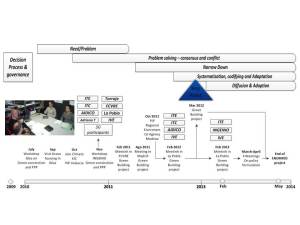
The presentation aims to analyse the interaction experience of a multidisciplinary team in the formulation process of the renewable energy local normative. A set of different elements on the formulation process and the content of the normative will be analysed by exploring the concept of reflexive governance. For doing so, focus will be put in the search of agreement and consensus by considering different interpretation of innovation polices as public procurement for R&D and green procurement as well as more general concepts as governance, participation and decision making mechanisms. Finally key issues of action research approach will be described in term of the the role of local environments on the generation, exchange and knowledge transfer as key drivers for the design and implementation of environmental regulation.
CW 7_pic

The presentation is based in the participation of the authors in the project Mediterranean renewables energy ENERMED. The project seeks to bring coherence to Mediterranean regional policies on renewable energy for innovation and competitiveness. Our skills will contribute to understanding.

More info:

http://www.ustream.tv/channel/informatius

Draft Normative Proposal

Agenda Final Event

Technical Report

Blog at WordPress.com.

Up ↑