Redefining the Role of STI Policy in Achieving Just Sustainability Transitions

I had the privilege of participating in an insightful panel organised by OECD with a very diverse group of speakers to address this challenging topic : Jessica Ambler, Henrik Larsen, Mikael Román, Dmitry Plekhanov,Guillermo Anlló, and Ana Persic.

We we explored recommendations, guidelines or tools recently deployed to support relevant stakeholders in guiding the development of STI activities and outputs to prepare for and respond to global systemic threats. Exchanges between panelists and with the audience might focus on unpacking:

– Whether the scientific process and modern STI policy are well-equipped to support the realisation of just and inclusive sustainability transitions.

– The roles that IOs, specifically, can play in promoting and informing (transformative STI and STI policy reforms to enable transitions.

– Good practice and lessons learned through practical experience of supporting STI and STI policy in contributing to transitions.

The most critical challenges to mobilising STI to contribute to sustainability transitions and how IOs can help to overcome them.

Co-creation for Policy: Multi-actor agency enabling transformation processes

Co-creation for policy with a wide range of actors – including governments, civil society and business at all levels – is essential for building the capacity to act in complex and uncertain circumstances. To support the journey of transformational processes, co-creation for policy needs to take place at all levels of governance. Agency (capacity to act) varies from actor to actor and depends on the context. How best to organise this capacity? Which actors are best suited to act at which stages? Understanding the potential of the co-creation process to enable multi-actor agency can play a vital role in developing policies and interventions in the coming decades. Using examples at project, programme and multi-location levels, this webinar will illustrate processes and practises that support building multi-actor agency through co-creation processes in the context of strategic intervention areas to address sustainability transitions.

Reflexive governance and action research for local renewable energy policy in Spain

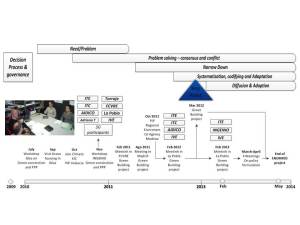
Innovation in process of policy design by reflexive governance and action research. The case of renewable energy policy in Pobla de Vallbona

The presentation aims to analyse the interaction experience of a multidisciplinary team in the formulation process of the renewable energy local normative. A set of different elements on the formulation process and the content of the normative will be analysed by exploring the concept of reflexive governance. For doing so, focus will be put in the search of agreement and consensus by considering different interpretation of innovation polices as public procurement for R&D and green procurement as well as more general concepts as governance, participation and decision making mechanisms. Finally key issues of action research approach will be described in term of the the role of local environments on the generation, exchange and knowledge transfer as key drivers for the design and implementation of environmental regulation.
CW 7_pic

The presentation is based in the participation of the authors in the project Mediterranean renewables energy ENERMED. The project seeks to bring coherence to Mediterranean regional policies on renewable energy for innovation and competitiveness. Our skills will contribute to understanding.

More info:

http://www.ustream.tv/channel/informatius

Draft Normative Proposal

Agenda Final Event

Technical Report

Blog at WordPress.com.

Up ↑