Co-creation for policy with a wide range of actors – including governments, civil society and business at all levels – is essential for building the capacity to act in complex and uncertain circumstances. To support the journey of transformational processes, co-creation for policy needs to take place at all levels of governance. Agency (capacity to act) varies from actor to actor and depends on the context. How best to organise this capacity? Which actors are best suited to act at which stages? Understanding the potential of the co-creation process to enable multi-actor agency can play a vital role in developing policies and interventions in the coming decades. Using examples at project, programme and multi-location levels, this webinar will illustrate processes and practises that support building multi-actor agency through co-creation processes in the context of strategic intervention areas to address sustainability transitions.
Introducing participatory methods and co-creation for policy to PhD students
The general objective of the course is to provide students with theoretical and applied knowledge about different participatory methods for multi-actor engagement in co-creation of interventions in contexts of change designed from a social impact perspective, which represents an essential part of the methodological area of the Doctorate in Innovation Economy of the University of San Martín The design and implementation of policies and actions for innovation and systems transformation requires an inclusive approach that incorporates the perspectives of the different actors and sectors involved. In this sense, participatory methods and knowledge management from an interface of political science and practice enable mechanisms for constructive dialogue, joint co-creation processes and the development of helpful information for decision-making.
Transition Policy Labs. Enabling capacity building, experimentation and design for policy to the practitioners community

In 2021, The Transition Policy Lab series supported policymakers in different countries to introduce policy-making practises by removing barriers to enable the necessary institutional change. It aimed to build capacity for co-designing and implementing systemic policies that can lead to transformative strategies and actions.
The #EIT Regional Innovation Scheme’s Transition Policy Labs, developed by the Transitions Hub, consisted of five interconnected capacity-building activities delivered in three different formats: Multi-stakeholder setting, science-based training and executive programmes.
Transitions Policy Labs Series 2021
- Co-creation for policy Here Knowledge Partner: Joint Research Centre
- X-Curve for exploring transition dynamics Here Knowledge Partner: Drift for transitions
- Value Network Mapping Here Knowledge Partner: Vito
- MEL Addressing Transformative Change Here Knowledge Partner: Transformative Innovation Policy Consortium & MOTION project
- Transformative Innovation Policy Here Knowledge Partner: Austrian Institute of Technology
Capacity building agenda on joint programming in the circular economy. An instructional design approach

In the CICERONE project, we developed a capacity-building agenda as part of a collaborative framework by using triangulation of different methods, including input from programme officers and a series of sensemaking sessions organised to discuss different aspects of the agenda and align them with the MOOC, the Policy Toolkit and the Roadmap respectively. This strategic framework follows an improvement pathway logic where gaps and opportunities are addressed through a combined multi-level capacity development and instructional design model that allows for a tailored and contextualised approach to deliver actionable knowledge and ensure the best possible match between programme owner needs and available resources.
Download the report CICERONE Strategic Agenda for Institutional Capacity Building HERE
A system innovation approach for schools

In 2017, the Visual Toolbox for System Innovation was part of a lab to develop new tools for schools. Considering a modular approach, including the EIT RM @Schools approach and other methods proposed by partners of both KICs, such as myclimate and Solutions for the Planet, they were part of the design, testing and implementation of an integrated common module.
The @GreenSchools aim to improve human capital by extending high-quality and inspiring training and methodologies developed by the 6 existing KICs for higher education to the wider society to promote a more open, innovative and entrepreneurial mindset.
Download the @GreenSchools Guideline HERE
This project was the nucleus for the Young Innovators Programme launched in 2018, which aims to support teachers and educators in improving systems thinking and solving complex problems in the classroom. The emergence of this Young Innovator Programme points us to the application of the challenge-based approach in the educational context. This is a collective problem-solving perspective originally developed by the Climate KIC Transitions Hub to address transitions to sustainability in socio-economic systems. The aim of the training for teachers is to introduce a systems innovation approach that raises awareness of climate change challenges and promotes creative thinking and climate innovation skills among the younger generation (12-18 years).
The resulting Teacher’s Guide is a comprehensive handbook for teachers and educators with clear steps and practical tips on facilitation.
Download Teacher’s Guide HERE
Social Innovation and action-research in schools

Action research project introducing system thinking in València Schools within the Context of the Educating Cities Association (2017)

Sustainability transitions, green skills & water management. New practices for professional education
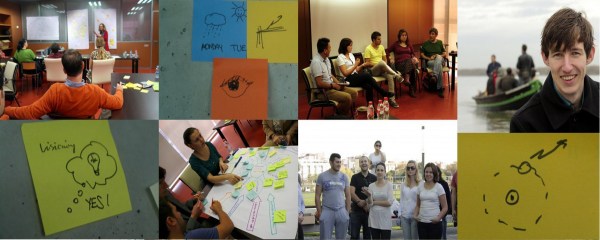
Climate-KIC offered an eight day coached sustainability transitions course for experienced environment and water management professionals, held in Valencia (Spain) from 22nd until 29th November 2014. It was designed to provide the key competencies and capabilities to be an innovator in the broad sense of this term. More than 35 people, from 15 different countries, were working on ‘Green skills’ in a programme designed to upgrade professional competences to face climate and sustainability challenges. The principal novelty of the course was to introduce horizontal and cooperative methods of working, involving low-profile hierarchies and greater autonomy. Hence, participants were collaborating hand-by-hand with international, regional specialists and problem owners related with climate change within a “project meeting” atmosphere.
Cristian Matti, social science researcher, together with Professor Anne J. Wieczorek and Coach Javier de Vicente, coordinated a team of well-known international experts including Jan Jonker, Corporate Sustainability; Todd Gartner, Water Management and Innovation; Caroline Van Leenders, Process Manager in Sustainable Transitions; and, Fernando J. Díaz López, Eco-innovation for Green economies. Furthermore, several regional experts participated in debates activities trying to reproduce real working negotiations with stakeholders. Additionally, participants have enjoyed study visits to actual projects in the regeneration area of Turia River and Naturals Park l´Albufera. A diverse set of activities such as breakfast and lunch seminars, workshops, world cafe or pitching, were performed horizontally in order to help participants to realize which skills are needed the most to deal with sustainability transitions enforced by climate change: thus, first, to be able to identify barriers, identify opportunities or stakeholders analysis; second, to be able to develop solutions –new business models– with system innovation projects, focus priorities for further exploration or low carbon innovation; and, finally, make transitions happen –plans into actions–. This pilot initiative performed as a living lab experience for both participants and experts who explored new learning techniques by shifting the role of experts, participants and speakers towards a more horizontal context of professional interaction. This particular program forms part of the Innovator Catalyst series and was aimed at experienced professionals with the enthusiasm and potential for influencing organizational change and system innovation. It was also organized by INGENIO (CSIC-UPV), Polytechnic University of Valencia and Vaersa.
Take a look at our experience
https://www.youtube.com/watch?v=8tZvRwIJzjM&t=4s
Innovator catalyst roadmap
The Pioneers into Practice experience. Blending capacity building, policy experimentation and innovation for professionals in Climate Change


The Pioneers into Practice (PIP) programme offered a platform for policymakers and practitioners to study, design and promote day-to-day professional practices in business, government and research. Climate-KIC is one of three Knowledge and Innovation Communities (KICs) created in 2010 by the European Institute of Innovation and Technology (EIT). This community of European partners from the private, public and academic sectors engages in various activities to offer new solutions for innovation, entrepreneurship and training.
I joined PIP in 2010 when it was just a pilot initiative, and I discovered as a Pioneer new forms of interaction between professionals involved in environmental innovation. I became a Regional mentor in 2012, and since that moment, I have applied different methodologies to foster group dynamics in exploring business and research ideas within a participatory environment. In 2014, as the Coordinator of regional coaches in Valencia, I had the challenge of designing activities, developing materials and guiding a team of professional coaches to encourage pioneers to think “out of the box” and apply the Transition approach through an intensive and interactive process of professional upgrade.
PIP group 2012

PIP group 2013

PIP group 2014
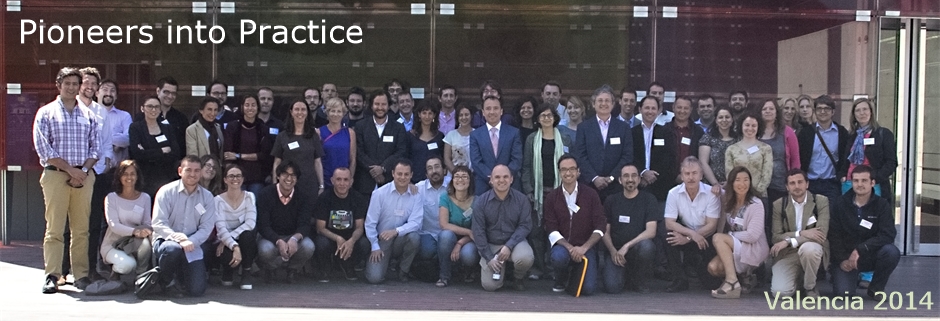
The critical element of the programme was upgrading multidisciplinary professional skills through opportunities and broadening the professional and institutional networks among different knowledge fields and geographies. Participants explore visions of new low-carbon scenarios and opportunities to innovate in different knowledge areas such as transport, buildings, energy networks, and water management. Still, they also integrate professional capacities in organizational, technological, natural science, economics and many other fields.
The video below collects different perspectives on the experience of the Pioneers into Practice programme.
Facilitating process of capacity building on knowledge Transfer and Licensing

University of LLeida (Spain) – Universidad Austral (Chile)
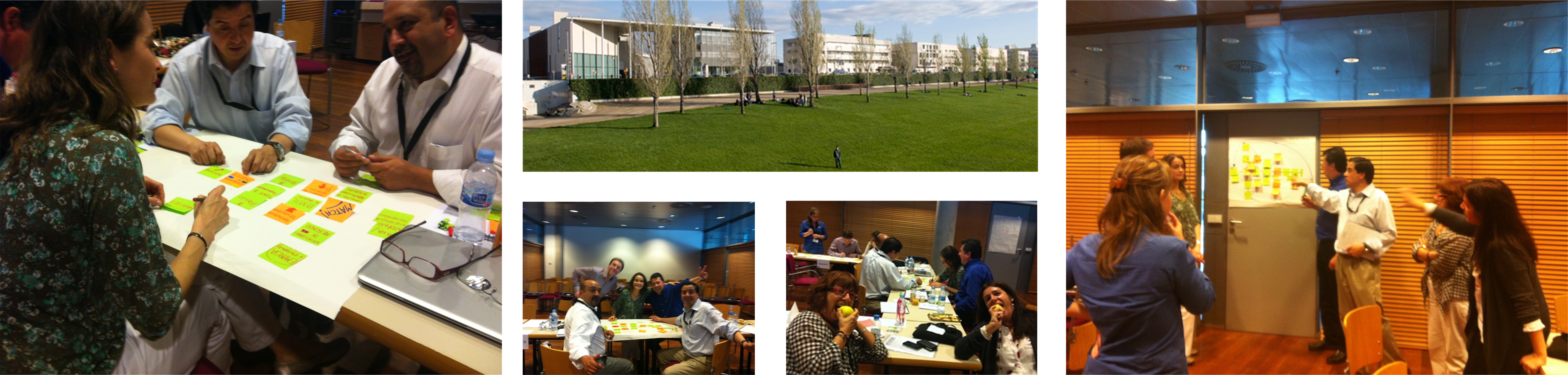
Trainin g / coaching touring around the comprehensive system of knowledge transfer, from the beginning to the market launch. Presentation of different cases on
knowledge transfer offices and describing the most successful models of management. The training will include topics on intellectual property units, enhancement of knowledge, passing the incubation phase of the company in its initial period and ending with the maturing of this company with specific support for stabilization in the market. The workshops seek the exploration of ways to encourage scholars to perform these tasks, since usually the incentive systems of the university depend on the scientific production of the researcher and not entrepreneurship is valued.
Training presentationPresentation AUCH Lleida
Presentation Llerida_Cristian Matti
University of Lleida
Corporate sustainability and corporate social responsibility

Master in Management of Science and Innovation – INGENIO (CSIC-UPV)
Strategies and actions of companies and organizations to the environmental and social problems. The responsible company and sustainable operation. Business ethics and corporate reputation. Corporate Social Responsibility in the strategic management of companies and other organizations. Management of Social Responsibility Corporate and sustainability and its relation to environmental innovation and social innovation, eco-efficiency and eco-design. Eco-innovation, consumption patterns and environmental policies. Determinants of sustainable consumption patterns and behavior.

Related links:
Contents (in Spanish)
Master in Management of Science and Innovation
Institute of Innovation and Knowledge Management ǀ INGENIO (CSIC-UPV)
 CRISTIAN MATTI
