Quality of life, social innovation and living lab methodologies

Fostering quality of life through social innovation: a living lab methodology study case

Mónica E. Edwards-Schachter, Cristian Matti, Enrique Alcántara

Review of Policy Research

Participative processes and citizens’ empowerment are crucial aspects of social innovation (SI), involving collaborative activities between the private, public, and third sectors. This article discusses the principal trends in the literature on SI, its aims and differential characteristics related to identifying people’s needs, citizen participation processes, and improved quality of life. We present an exploratory case study of SI focusing on the gap between elderly people’s needs and the generation of business opportunities, using a living lab (LL) methodology for collaborative placed-based innovation. Our results suggest that LLs are a helpful instrument to detect community needs, improve local development, and support and integrate technological and social innovations in policies and local governance processes

http://onlinelibrary.wiley.com/doi/10.1111/j.1541-1338.2012.00588.x/abstract

Networks and innovation processes in two Argentinean regions

INNOVATIVE PROCESSES AND NETWORKS IN TWO MUNICIPALITIES OF BUENOS AIRES

Procesos innovativos y redes en dos municipios del conurbano bonaerense

Patricio Narodowski, Cristian Matti

This paper was based in my first work in research. It is part of a large study on the Petrochemical – Plastic value change and it base in a series of interviews to firms of two mayor industrial districts. I got big lesson on research methods and fieldworks by doing this job but I also start to explore the concept of networks from a much applied perspective.

Link to full document (in Spanish): http://www.ub.edu/geocrit/sn/sn-170-29.htm

Reflexive governance and action research for local renewable energy policy in Spain

Innovation in process of policy design by reflexive governance and action research. The case of renewable energy policy in Pobla de Vallbona

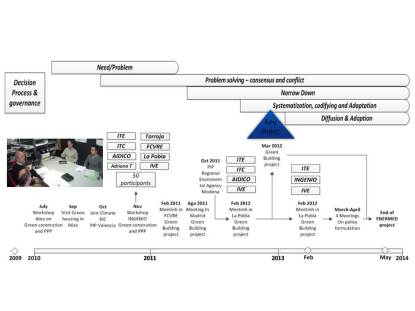
The presentation aims to analyse the interaction experience of a multidisciplinary team in the formulation process of the renewable energy local normative. A set of different elements on the formulation process and the content of the normative will be analysed by exploring the concept of reflexive governance. For doing so, focus will be put in the search of agreement and consensus by considering different interpretation of innovation polices as public procurement for R&D and green procurement as well as more general concepts as governance, participation and decision making mechanisms. Finally key issues of action research approach will be described in term of the the role of local environments on the generation, exchange and knowledge transfer as key drivers for the design and implementation of environmental regulation.
CW 7_pic

The presentation is based in the participation of the authors in the project Mediterranean renewables energy ENERMED. The project seeks to bring coherence to Mediterranean regional policies on renewable energy for innovation and competitiveness. Our skills will contribute to understanding.

More info:

http://www.ustream.tv/channel/informatius

Draft Normative Proposal

Agenda Final Event

Technical Report

Diverse perspectives on knowledge creation in the Spanish Innovation System

Diverse perspectives on drivers and hampering factors for the creation of knowledge in organizations: an approach to the Spanish Innovation System.

Cristian Matti & Rodrigo Martinez Novo

OLKC 2012  International conference on organizational learning, knowledge and capabilities

Valencia 25/27 April 2012

This Paper was developed as part of the PICK ME project. It was the first exercise on discourse analysis by using Atlas.ti software. We have explored the discussion bettwen scientist, entrepreneurs and government official coming from a debate on system of innovation.

Methodologically, we applied interpretative repertoire to track the connection between different ideas and value systems. The paper reveals some interesting insight on the culture of innovation and the rationale behind the use of policy instruments to foster innovation but especially at regional level

CW 5_pic

Link to conference program: http://www.olkc2012.com/detail-program/89.html

Program.

Transport Systems, Greenhouse Gas Emissions, and Mitigation Measures: A Study in Argentina

World bankSome of the results from the consultancy on Transport sector for the Second comunicaction of Argentina for the United Nation Framework Convention on Climate Chgue were introduced here as part of the 5th urban research symposium on cities and climate change responding to an urgent agenda, held in Marseille in June 2009

Ravella, O., Matti, C., Giacobbe, N., Aon, L., Frediani, J. (2011). Transport Systems, Greenhouse Gas Emissions, and Mitigation Measures: A Study in Argentina. In Gupta, R., Chandiwala, S. Cities and Climate Change.  Responding to an Urgent Agenda. Urban Development Studies, World Bank, Appendix pp. 278.

Online resource

Methodologies for national and regional statistics in Argentina

 Survey and fieldwork methods  – National economic census 2004/2005 Argentina

During 2004-2005 I had the opportunity of join the National economic Census in Argentina. I was appointed as regional methodological chief for many different municipalities across the province of Buenos Aires, the biggest and richest region in Argentina.

Census regionsTwo of these municipalities were part of the biggest concentration of population in Argentina: Avellaneda and Lanus while the other were located in the south of Buenos Aires place of the most important agricultural activity.  This was a first experience on professional training but also as chief of a big team as I was in charge of the training of regional coordinators and regional trainers (i.e. methodological issues on gathering information, survey management and human resource recruitment and management) but also the methodological supervisor during all the project. Thousands of kilometres later, I had carried out selection process, training, coordination and supervision of more than 50 professionals who were at the same time in charge of more than 200 pollster. The experience was great and the results has changed the perception of the regional economy. (Here some results)

Regional business directory and economic demography

Conceptual and methodological proposal on a regional business directory for studies on economic demography

This working paper was drawn from an analysis of two main resources: the design and operation history directory companies “DIPUE system” and international experiences directories and business demographics. In this document the new model of Directory of Economic Units of the Province of Buenos Aires was proposed. It was aimed to improve the systematization of information, access to it and generate new statistical products for the public and private sector. Its content serves as basis for the preparation of the Procedures Manual and, in turn guide the planning of tasks to implement changes and any discussions on future applications, such as the Geographic Information Systems.

Download working paper here: Business Directory Methods Cristian Matti_2006 (Spanish)

UNFCC and Climate Change mitigation measures in Argentina

Second National Communication of the Argentina to the United Nation Convention for the Climate Change

The project was a mayor advance for Argentina in term of the design and evaluation of technological and non-technological measures to mitigate the effect of climate change. It was funded by the World Bank and supervised by experts of Intergovernmental Panel on Climate Change (IPCC) and delegates of United Nation Convention for the Climate Change (UNFCC).

This project was my first multidisciplinary experience. I joined multidisciplinary teams of architect, engineers, and geographers, GIS experts and sociologist to explore different projects and policy measures in two exiting areas: transport and energy efficiency in building. I have learnt a lot on methodologies for project evaluation and estimation of CO2 emissions but I also got a critical view of the economist in this kind of analysis.
The experience boosted my enthusiasm to learn more on multi-inter-trans and cross disciplinary studies on climate change. It was the seed and then, I started to think in Europe.

UNFCC website – Full document (Spanish)

Blog at WordPress.com.

Up ↑