Policy lessons on multi-level governance. The EU RIS model in Chilean regions

This study provides evidence of the policy learning process related to the translation and adaptation of a regional policy model to a new context while implementing a mayor process of transference of competences.  Emphasis is put in the process of translation and adaptation of an external regional policy model (the EU RIS scheme) by looking at the different understandings of regional system of innovation through the analysis of regional assessments and proposals for regional innovation strategies designed by Chilean regions. By doing so, this study seeks to identify the critical elements related to capacity building at different level regarding the development of new institutional frameworks and coordination mechanism by considering the agency issues and different regional settings.

The case of Chilean regions is a concrete example from the few experience on adapting European policies in other context. It is also a relevant case regarding the re-configuring of multilevel governance system to support innovation in an emergent and globalized economy. Empirical study is base in document review and content analysis techniques as well as complementary interviews to policy officers. Results shows an increasing autonomy of the regional governments while main policy instruments and resources still keep under central coordination.

Reverse engineering for multilevel governance. Lessons learnt from the application of EU RIS model in Chilean regions
11th Regional Innovation Policies Conference 2016.  
Cardiff University in Wales on the 3 and 4 November 2016
Catalina Terra  – Universidad de Chile  & Cristian Matti – Utrecht University & Climate KIC

Reflexive governance and action research for local renewable energy policy in Spain

Innovation in process of policy design by reflexive governance and action research. The case of renewable energy policy in Pobla de Vallbona

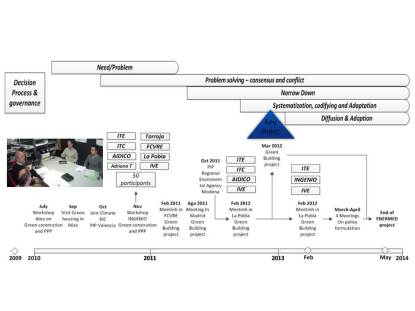
The presentation aims to analyse the interaction experience of a multidisciplinary team in the formulation process of the renewable energy local normative. A set of different elements on the formulation process and the content of the normative will be analysed by exploring the concept of reflexive governance. For doing so, focus will be put in the search of agreement and consensus by considering different interpretation of innovation polices as public procurement for R&D and green procurement as well as more general concepts as governance, participation and decision making mechanisms. Finally key issues of action research approach will be described in term of the the role of local environments on the generation, exchange and knowledge transfer as key drivers for the design and implementation of environmental regulation.
CW 7_pic

The presentation is based in the participation of the authors in the project Mediterranean renewables energy ENERMED. The project seeks to bring coherence to Mediterranean regional policies on renewable energy for innovation and competitiveness. Our skills will contribute to understanding.

More info:

http://www.ustream.tv/channel/informatius

Draft Normative Proposal

Agenda Final Event

Technical Report

Diverse perspectives on knowledge creation in the Spanish Innovation System

Diverse perspectives on drivers and hampering factors for the creation of knowledge in organizations: an approach to the Spanish Innovation System.

Cristian Matti & Rodrigo Martinez Novo

OLKC 2012  International conference on organizational learning, knowledge and capabilities

Valencia 25/27 April 2012

This Paper was developed as part of the PICK ME project. It was the first exercise on discourse analysis by using Atlas.ti software. We have explored the discussion bettwen scientist, entrepreneurs and government official coming from a debate on system of innovation.

Methodologically, we applied interpretative repertoire to track the connection between different ideas and value systems. The paper reveals some interesting insight on the culture of innovation and the rationale behind the use of policy instruments to foster innovation but especially at regional level

CW 5_pic

Link to conference program: http://www.olkc2012.com/detail-program/89.html

Program.

Applying participatory process for supporting Regional Innovation Strategies (RIS) and competence-based training in Chile

Competence-based Postgraduate course  for policy officers on Innovation and Territory

Secretariat for Regional and Administrative Development (SUBDERE) Chile

In 2012-2013, I had the inspiring experience of coordinating a blended professional course for more than 80 academics and R&D regional officers of 14 Chilean regions. The main areas of interest are regional systems of innovation and policy instruments. The initiative was part of the Proyecto RED (2010-2013). The EU supported the Chilean government and regions to develop regional innovation policies using the EU RIS methodology Smart Specialization Strategies (RIS3).

Organization of intensive workshops designed with techniques to foster networking, collaboration and problem-solving mechanisms. With that respect, one of the most exciting challenges was the application of participatory process techniques to fostering dynamics among groups of participants from very different Chilean regions. Nice experience

Chile

Presencial Chile

UNFCC and Climate Change mitigation measures in Argentina

Second National Communication of the Argentina to the United Nation Convention for the Climate Change

The project was a mayor advance for Argentina in term of the design and evaluation of technological and non-technological measures to mitigate the effect of climate change. It was funded by the World Bank and supervised by experts of Intergovernmental Panel on Climate Change (IPCC) and delegates of United Nation Convention for the Climate Change (UNFCC).

This project was my first multidisciplinary experience. I joined multidisciplinary teams of architect, engineers, and geographers, GIS experts and sociologist to explore different projects and policy measures in two exiting areas: transport and energy efficiency in building. I have learnt a lot on methodologies for project evaluation and estimation of CO2 emissions but I also got a critical view of the economist in this kind of analysis.
The experience boosted my enthusiasm to learn more on multi-inter-trans and cross disciplinary studies on climate change. It was the seed and then, I started to think in Europe.

UNFCC website – Full document (Spanish)

Blog at WordPress.com.

Up ↑